
The APEX Wire: The APG APEX
Executive Summary
The Blackpoint Adversary Pursuit Group (APG) provides vulnerability threat notices to reduce noise and surface vulnerabilities with meaningful operational relevance for managed environments.
This blog explains why effective prioritization requires more than severity scores alone, how contextual risk helps MSPs and SMBs focus on what matters most, and introduces the APG APEX framework for doing just that.
The Cost of Treating Every CVE The Same
Security teams do not struggle with a lack of vulnerability data. They struggle with prioritization.
In 2025, nearly 50,000 vulnerabilities were reported, with more than 30% rated High (7.0–8.9) or Critical (9.0–10.0) on the Common Vulnerability Scoring System (CVSS). That trend has continued into 2026, with more than 26,000 reported so far and over half classified as High or Critical. Rather than helping defenders focus, this volume often creates the opposite effect.
As volume grows, so does the number of severe vulnerabilities competing for attention. The challenge lies in determining which of the thousands of vulnerabilities warrant immediate action, which require monitoring, and which represent more noise than genuine operational risk.
For MSPs and SMBs, that distinction is especially important. Not every high-severity vulnerability presents the same risk across shared infrastructure or resource-constrained environments.
CVSS: A Starting Point, Not a Strategy
CVSS remains one of the most widely used frameworks for assessing vulnerability severity. It provides a standardized way to evaluate exploitability, required privileges, user interaction, and potential impact to confidentiality, integrity, and availability, making it a useful baseline for technical severity.
However, a High or Critical CVSS score does not inherently reflect how relevant a vulnerability is to a specific environment.
A critical weakness in low-prevalence software may create limited concern for one organization, while a lower-scored vulnerability in identity infrastructure, remote access tooling, or widely deployed administrative platforms may carry far greater operational risk for others.
CVSS does not indicate how likely a vulnerability is to be exploited in the wild. The Exploit Prediction Scoring System (EPSS) can supplement it by estimating exploitation likelihood, offering additional insight into threat actor interest and real-world activity. Even so, exploitation likelihood alone does not determine urgency.
| Framework | What it Helps Answer | What it Does Not Tell You |
|---|---|---|
| CVSS | How severe could this vulnerability be? | Whether it matters for your environment |
| EPSS | How likely is exploitation? | Whether it creates operational urgency |
| Contextual Intelligence | What risk does this create for our customers? | N/A – this is where prioritization occurs |
In MSP and SMB environments, shared tooling, centralized access, and resource constraints can significantly affect how a vulnerability should be prioritized. Risk is shaped not only by technical severity on paper, but by where the vulnerability exists, how it could be leveraged, and the operational impact its exploitation could create.
CVSS provides the starting point. Effective prioritization requires additional context, including real-world exposure, attacker interest, customer relevance, and operational impact.
Why Risk Looks Different for MSPs and SMBs
Vulnerability risk is not experienced uniformly across organizations. The same vulnerability can have significantly different operational consequences depending on the environment it affects, the software or service it impacts, and the level of trust associated with that software or service.
What Changes Priority in Managed Environments
- Shared tooling and centralized access
- High-trust administrative platforms
- Multi-customer or multi-system impact
- Operational dependency on critical services
- Recovery, visibility, or access disruption
- The ability for risk to scale beyond a single asset
For MSPs, risk is amplified by scale and centralization. Shared administrative tooling, remote management platforms, identity systems, and automation services can broaden operational exposure, as a single exploited vulnerability may affect multiple customers, trusted workflows, or critical infrastructure.
For SMBs, risk is shaped by operational dependency and limited resources. Smaller security teams, reduced network segmentation, and constrained recovery capabilities can make operational impact disproportionate. Vulnerabilities affecting access, visibility, backups, or business critical platforms often demand immediate attention, regardless of their technical severity rating.
Effective vulnerability prioritization must therefore extend beyond severity and account for environmental context: how a weakness could scale, where trust exists, and what operational impact exploitation could create.
At Blackpoint, vulnerability threat notices are built with this reality in mind. Prioritization focuses on identifying vulnerabilities that create meaningful urgency for MSPs and SMBs, reducing noise while surfacing the risks most likely to affect the environments our customers protect. In managed environments, one exploited vulnerability can quickly become many problems.
Signals That Change Urgency
Severity and exploit likelihood provide important context, but neither independently defines urgency. Prioritization becomes more precise when technical indicators are evaluated alongside environmental relevance and operational risk.
The APG APEX™ evaluates four categories to determine where urgent action is warranted.
Severity
Likelihood
Relevance
Risk
- Technical Severity: helps establish potential impact.
- Exploitation Likelihood: provides insight into real world attacker opportunity.
- Environmental Relevance: helps determine whether a vulnerability meaningfully impacts MSP and SMB environments.
- Operational Risk: reflects how exploitation could impact trust, access, visibility, recovery, or business continuity.
Together, these layers refine which vulnerabilities require timely action. The Blackpoint APG evaluates technical severity alongside exploitation likelihood, environmental relevance, and operational risk to help MSPs and SMBs focus quickly on what matters most.
The Goal is Precision, Not Volume
Effective vulnerability intelligence is not measured by how many advisories are published. It is measured by how consistently attention is directed toward risks, which are most likely to create meaningful operational impact.
Not every vulnerability will generate a threat notice, and not every notice will represent immediate risk for every customer. Managed environments vary, and software exposure is rarely uniform across all MSPs, SMBs, or the systems they rely on.
Effective prioritization cannot be built on severity alone. Technical severity, exploitation likelihood, environmental relevance, and operational risk all contribute to understanding where urgency exists and where attention is most needed.
At Blackpoint, the goal is not to surface every possible issue. It is to help MSPs and SMBs focus on vulnerabilities that require timely attention, while also providing visibility into risks that might otherwise be lost in the volume of daily disclosures, emerging exploitation, and competing operational priorities.
DATE PUBLISHEDSeptember 3, 2026
AUTHORAndi Ursry
SHARE ON
The Cost of Waiting
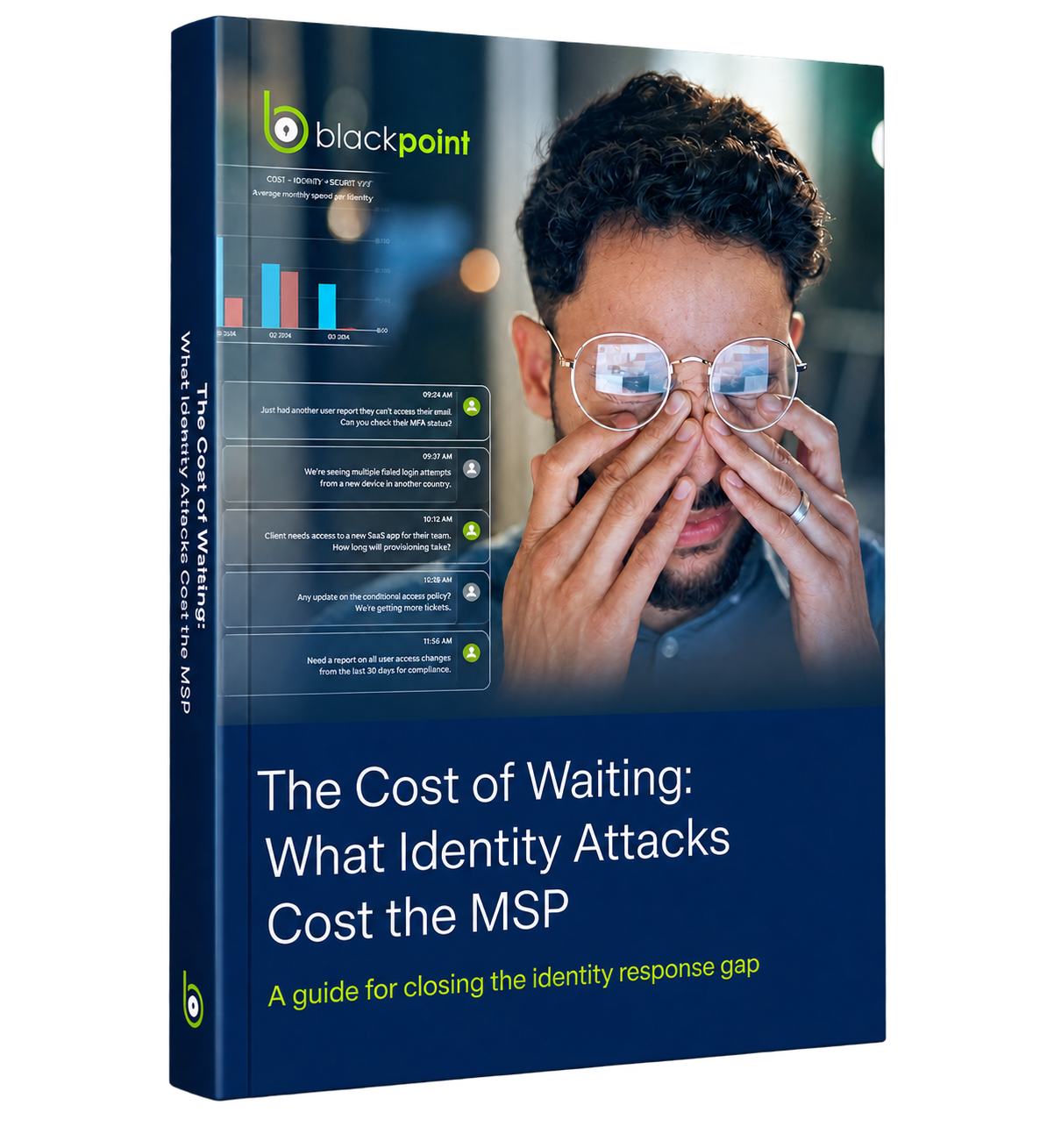 What Identity Attacks Cost the MSP
Stolen credentials don't trip alarms. Once an attacker is authenticated, they look like anyone else, and most tools aren't watching what happens next. Learn what closing the identity response gap looks like: how identity attacks happen, where response slows down, and the questions to ask any ITDR vendor.
What Identity Attacks Cost the MSP
Stolen credentials don't trip alarms. Once an attacker is authenticated, they look like anyone else, and most tools aren't watching what happens next. Learn what closing the identity response gap looks like: how identity attacks happen, where response slows down, and the questions to ask any ITDR vendor.
*Identity-based techniques play a role in nearly 90% of incident investigations